






Golf is one of those card games that sounds gentle until you play two rounds and realize it’s a quiet score war. You’re not trying to build the biggest hand—you’re trying to avoid points. That simple twist is why the game stays popular in living rooms and travel nights: it’s easy to learn, quick to reset, and still gives you real decisions.
So, how golf card games works? You get a small grid of face-down cards, reveal and swap to improve your score, and after a set number of rounds the lowest total wins.
It also adapts nicely as 2 player card games, because the core tension—what you reveal versus what you replace—still holds up head-to-head.
The main idea: low score wins
In most versions of Golf, you keep a layout of cards in front of you. Each round, you’re trying to finish with the lowest score possible.
The game runs for a fixed number of rounds (often 9, like actual golf—hence the name), but groups sometimes play fewer for speed.
The most common format: 6-card Golf (3×2 grid)
Many people learn Golf as a 6-card layout:
-
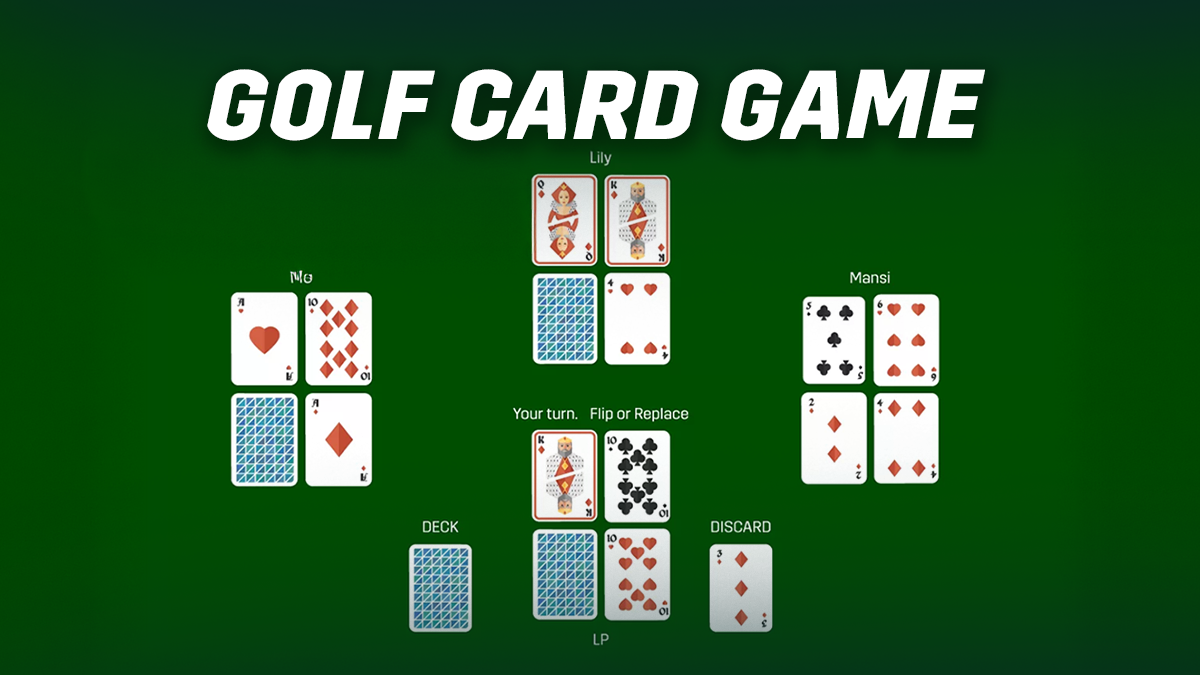
Each player gets 6 cards, arranged face down in a 3×2 grid.
-
At the start of the round, players typically flip two cards face up (often any two; house rules vary).
-
The remaining deck becomes the stock, and one card is turned face up to start the discard pile.
Your grid stays in place. You’re improving it, not reshuffling it mid-round.
What counts as a “good” grid?
The key mechanic in most Golf variants is matching cards in the same column (or sometimes row) to reduce points, often by canceling them out or lowering totals. This is where the “golf” feel comes from: you’re trying to remove damage.
Because house rules differ, the most important thing is agreeing on the scoring before you start.
Turn structure: draw, decide, replace
Each turn is simple:
-
Draw the top card from the stock or take the top card from the discard pile.
-
Decide whether to keep it.
-
If you keep it, you swap it with one card in your grid. The replaced card is then discarded face up.
-
If you don’t keep the drawn stock card, you discard it immediately (discarding a taken discard usually isn’t allowed—you took it for a reason).
Then play passes to the next person.
This creates the core tension: taking from discard is informative (everyone sees what you took), while drawing from stock is private until you decide.
Scoring basics (the common “starter” method)
Golf has multiple scoring systems. Here’s a beginner-friendly scoring set many groups use:
-
Ace = 1
-
2–10 = face value
-
J, Q = 10
-
K = 0 (or sometimes 10—house rule)
And the signature rule:
-
A pair in the same column cancels (that column scores 0).
Some tables also treat certain cards as special (like 2s or 10s), but if you’re learning, keep it plain for the first few games.
How a round ends: knocking and final turns
Most versions include a “knock” mechanic.
-
A player may knock when they believe their grid is strong (low).
-
After a knock, other players usually get one final turn to improve their grid.
-
Then everyone reveals all face-down cards and scores the round.
This makes knocking a timing decision, not just a button you press. Knock too early and someone else fixes their grid and beats you. Knock too late and you give away extra turns you didn’t need to allow.
Popular variations you’ll hear about
Golf is more a family than a single rulebook. These are the big branches:
4-card Golf (2×2)
Faster rounds, less information, more luck. Great for two players when you want a quick match.
9-card Golf (3×3)
Longer rounds, more planning, and column matching becomes a bigger theme.
“Birdie” rules and special card values
Some groups add special scores for certain ranks to increase swinginess. Fun, but agree clearly before the first deal.
One subtle insight beginners miss
In Golf, swapping isn’t just about improving your own grid. It’s also about what you give away.
Every time you discard, you’re offering information and possibly a perfect card to your opponent. A smart habit is to ask: “If I discard this, does it obviously complete a pair for them?” In two-player games especially, one generous discard can swing an entire round.
A quick tip for 2-player play
With two players, the discard pile becomes more “personal.” You’ll see each other’s patterns more clearly. If your opponent repeatedly swaps into the same column, they’re probably chasing a cancel. That doesn’t mean you can stop them—but it should change what you’re willing to throw away face up.
So, how golf card games works is straightforward: build a small grid, draw and swap to lower your score, use matching columns to cancel points, and decide when to knock so others don’t get too many cleanup turns. As 2 player card games go, Golf is a great blend of luck and quiet control—simple enough to teach in minutes, yet just tricky enough to keep you replaying “one more round.”